 by
by 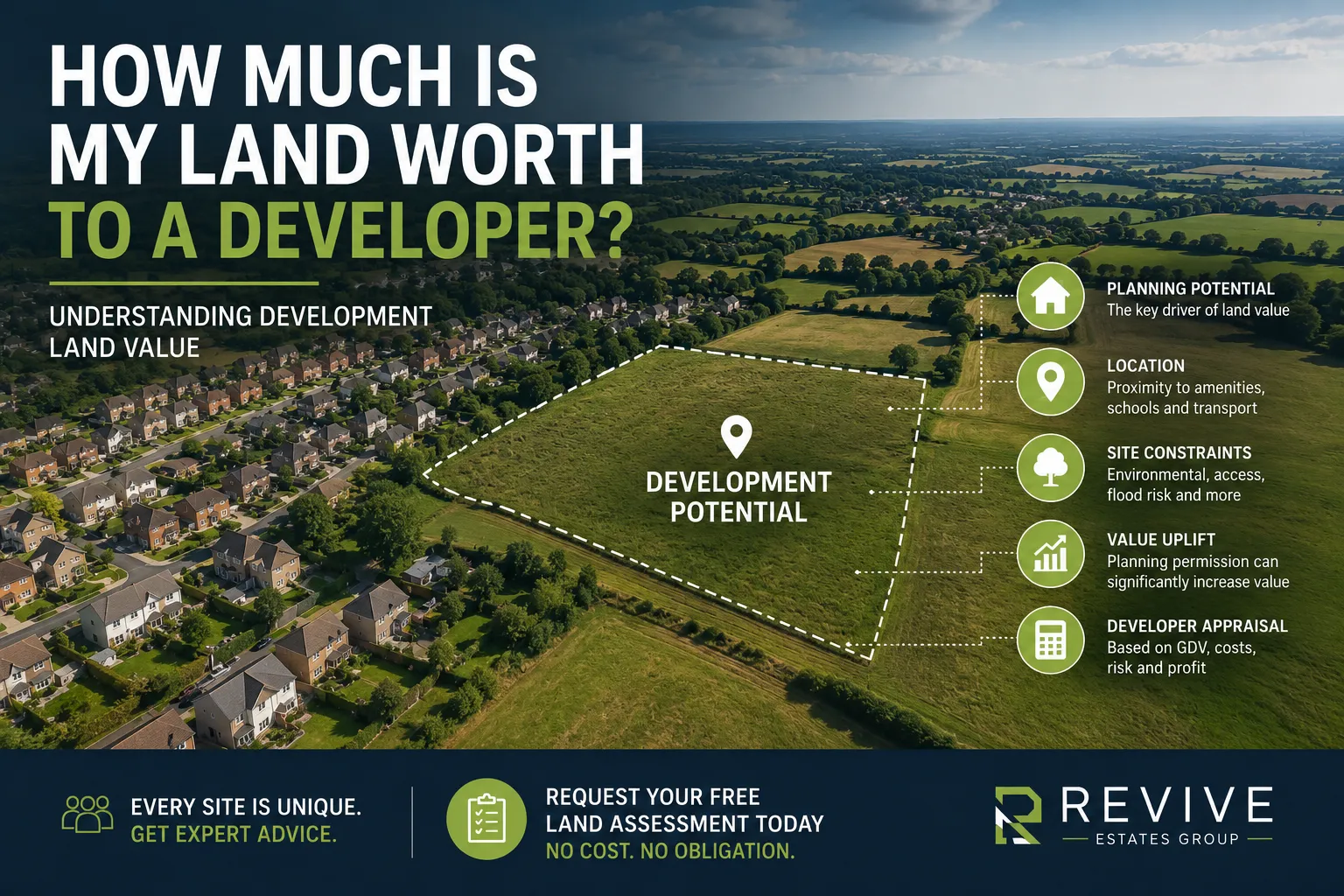
Development land can be worth anything from a few thousand pounds per acre to several million pounds, depending on its planning status, location and future potential. If you own land that could be developed, understanding how buyers assess value is essential before deciding to sell. This guide explains how development land is valued, why offers can vary significantly and how to maximise your land’s value before bringing it to market.
Introduction
One of the biggest misconceptions among landowners is that development land has a fixed value.
It doesn’t.
Unlike agricultural land or residential property, development land is valued according to what can potentially be built and what those completed properties are likely to sell for.
That means two neighbouring fields of the same size can have dramatically different values.
One may only be worth agricultural value.
The other could be worth several million pounds.
Understanding where your land sits on that spectrum is one of the most important steps before deciding to sell.
If you haven’t already, it’s worth reading our guide How Much Is My Land Worth?, which explains the wider factors that influence land values across the UK.
What Is Development Land?
Development land is land with the potential to be built upon.
This may include:
- Residential housing
- Commercial buildings
- Mixed-use developments
- Retirement villages
- Industrial estates
- Employment land
- Strategic land for future allocation
Some sites already have planning permission.
Others simply have long-term development potential.
Both can attract strong buyer interest.
Is There an Average Value for Development Land?
Unlike agricultural land, there is no meaningful average price per acre for development land.
That’s because value depends almost entirely on:
- Planning status.
- Number of units achievable.
- Local property prices.
- Development costs.
- Affordable housing requirements.
- Infrastructure obligations.
- Buyer demand.
A site capable of accommodating ten houses in one town may be worth considerably more than a larger site in another area. Residential building plots are valued differently from larger development sites. You may also find our guide How Much Is a Building Plot Worth? useful.
Tired of traditional agent fees?
YourLandStore charges 1% on successful sale only — no upfront costs, no site visits, no hidden charges.
List your land free today →Why Development Land Values Vary So Much
Development land is unlike any other asset.
Its value is influenced not only by today’s market but also by future planning policy, infrastructure investment and local housing demand.
Factors include:
- Planning permission.
- Local Authority
- Local house prices.
- Infrastructure costs.
- Utility connections.
- Ground conditions.
- Market demand.
- Planning policy.
- Affordable housing requirements.
- Biodiversity Net Gain (BNG) obligations.
- Community Infrastructure Levy (CIL), where applicable.
- Each of these factors can significantly affect what a developer is prepared to pay.
How Developers Calculate Development Land Value
Many landowners assume developers simply decide what they think the land is worth.
In reality, most professional developers use a process known as Residual Land Valuation.
Rather than starting with the value of the land, they begin with the value of the completed development.
They then deduct every cost involved in delivering that development.
Whatever remains is known as the Residual Land Value — effectively the maximum price the developer can afford to pay while still making an acceptable commercial return.
Understanding Residual Land Valuation
Expected Gross Development Value (GDV)
(Value of all completed homes)
│
▼
Less Construction Costs
│
▼
Less Professional Fees
│
▼
Less Planning, Legal & Technical Costs
│
▼
Less Infrastructure & Utility Costs
│
▼
Less Finance & Marketing Costs
│
▼
Less Developer’s Required Profit
(often a target commercial return)
│
▼
══════════════════════════════════
Residual Land Value
(The maximum a developer may be
prepared to pay for the land)
══════════════════════════════════
Developers don’t start by deciding what the land is worth. They start by estimating the value of the completed development, deduct every cost involved in delivering it—including construction, infrastructure, finance and a target commercial profit—and whatever remains becomes the residual land value. This represents the maximum price they can usually justify paying for the sit
Once their required profit disappears, the development no longer makes commercial sense.
Residual valuation is one of the reasons different buyers may produce very different offers for exactly the same site.It’s also important to remember that residual land valuation is only one method of assessing value. Different developers use different appraisal models, build costs and profit targets, meaning two developers can arrive at very different offers for exactly the same site. In addition, self-build buyers, investors and neighbouring landowners may value the same land using completely different criteria.
Our article Can I Sell My Land to a Developer? explains how developers assess opportunities before making an offer.
Why Different Developers Offer Different Prices
One of the questions we hear most often is:
“Why has one developer offered £500,000 while another offered £700,000?”
The answer is simple.
Every developer has different assumptions.
One developer may:
- Build more efficiently.
- Have lower borrowing costs.
- Expect higher selling prices.
- Already own neighbouring land.
- Require a smaller profit margin.
- Have existing contractors working locally.
As a result, different developers can arrive at very different land values despite assessing exactly the same site.
Hope Value and Strategic Land
Not all development land has planning permission.
Some land has what is known as hope value.
Hope value reflects the possibility that planning permission may be granted in the future.
Although planning consent is uncertain, buyers are sometimes prepared to pay more than agricultural value because they believe the land could eventually become suitable for development.
Strategic land goes a step further.
This is land that may not be developed for many years but is located close to expanding towns, proposed housing allocations or future infrastructure projects.
Strategic land often attracts:
- National housebuilders.
- Land promoters.
- Institutional investors.
- Strategic land companies.
Although planning may still be many years away, the long-term potential can significantly influence value. Hope value often applies to agricultural land on the edge of settlements. If that’s your situation, our guide How Much Is Agricultural Land Worth? explains how development potential can influence agricultural values.
Why a Self-Builder Might Pay More Than a Developer
One of the biggest misconceptions in the land market is that developers always pay the highest prices.
That isn’t necessarily true.
Developers calculate land value using commercial formulas.
Their offer is restricted by profit.
A self-builder is motivated very differently.
They may be looking for:
- Their forever home.
- A particular village.
- Better schools.
- Countryside views.
- Proximity to family.
- A bespoke home impossible to buy on the open market.
Because they are purchasing for lifestyle reasons rather than commercial profit, a self-builder may sometimes pay considerably more than a developer would be prepared to justify.
For single plots especially, this can make a significant difference to the eventual selling price.
Different Buyers Value Development Land Differently
| Buyer | Main Objective | May Pay Above Residual Value? |
| Self-builder | Build a dream home | Often |
| Small regional developer | Commercial profit | Sometimes |
| National housebuilder | Long-term land pipeline | Occasionally |
| Strategic land company | Future planning gains | Often |
| Land promoter | Planning uplift | Depends on agreement |
| Investor | Long-term capital growth | Sometimes |
This is why professional marketing is so important.
Restricting your land to one type of buyer may mean missing stronger offers from another part of the market.
Promotion Agreements and Option Agreements
Selling immediately is not always the best solution.
Some landowners choose to enter into:
Promotion Agreements
A land promoter works to secure planning permission at their own cost.
Once planning has been obtained, the land is sold on the open market and both parties share the increased value according to the agreement.
Option Agreements
A developer secures the option to buy the land at a future date if planning permission is achieved.
Both arrangements have advantages and disadvantages.
Choosing the most appropriate route depends on your objectives, timescales and appetite for risk.Not every landowner wants to sell immediately. Some choose land promotion to maximise future value. Our Strategic Development Land service explains how this approach can work.
Not sure whether to sell or explore development potential first?
Before you sell it’s worth understanding whether your land could be worth significantly more with planning permission. Our sister company Revive Estates offers free land assessments across the UK.
Get a free land assessment →Thinking About Selling Development Land?
Every development site is different.
At Your Landstore, we don’t simply advertise land.
We assess the type of buyer most likely to maximise its value and market it to a broad audience including:
- National housebuilders
- Regional developers
- Strategic land companies
- Land promoters
- Investors
- Self-build buyers (where appropriate)
By creating competition between different buyer types, we help landowners maximise their chances of achieving the strongest possible sale price .If you’re considering selling, visit our Sell Development Landell Development Land page to see how YourLandStore markets land nationwide through our transparent 1% No Sale, No Fee service.
Sell your land with YourLandStore
1% fee on successful sale only. No upfront costs. No site visits. UK-wide exposure on Zoopla and social media.
List your land →How it worksCommon Mistakes When Selling Development Land
Many valuable sites are undersold because landowners:
- Assume agricultural value is the correct benchmark.
- Accept the first developer’s offer.
- Ignore strategic development potential.
- Don’t understand hope value.
- Market privately to a single buyer.
- Fail to obtain professional advice before negotiating.
- Sell before understanding future planning policy.
The highest offer isn’t always the first offer.
Final Thoughts
Development land is one of the UK’s most valuable assets, but no two sites are valued in exactly the same way.
Planning permission, local property values, infrastructure costs, buyer demand and future development potential all influence what your land may be worth.
Understanding how developers calculate value—and recognising that self-builders, promoters and investors may all assess your land differently—can help you make more informed decisions before bringing it to market.
Professional marketing that reaches multiple buyer types often creates stronger competition and may significantly improve the final outcome.
Frequently Asked Questions
Is development land worth more than agricultural land?
Generally, yes. Land with development potential often commands significantly higher values than agricultural land because of the opportunity to build residential or commercial property.
What is residual land valuation?
Residual land valuation is the method developers use to calculate the maximum price they can afford to pay for land after deducting all development costs and their required profit from the expected value of the completed scheme.➡️ Building Plot Worth
What is hope value?
Hope value is the additional value attached to land because there is a realistic possibility that planning permission could be granted in the future.
Can a self-builder pay more than a developer?
Yes. Unlike developers, self-builders are often motivated by lifestyle rather than commercial profit, meaning they may be prepared to pay more for the right plot.
Should I sell directly to a developer?
Not necessarily. Marketing your land to a wider audience—including developers, promoters, investors and self-build buyers where appropriate—can create competition and help maximise the final sale price. At Your Landstore, we’re happy to discuss your land and explain the different options available before you make any decisions.